Homily 26 July 2026
Homily by Rev. Trish - 'The Parable of The Mustard Seed'

Christina (Tina) McKinlay
July 28, 2026
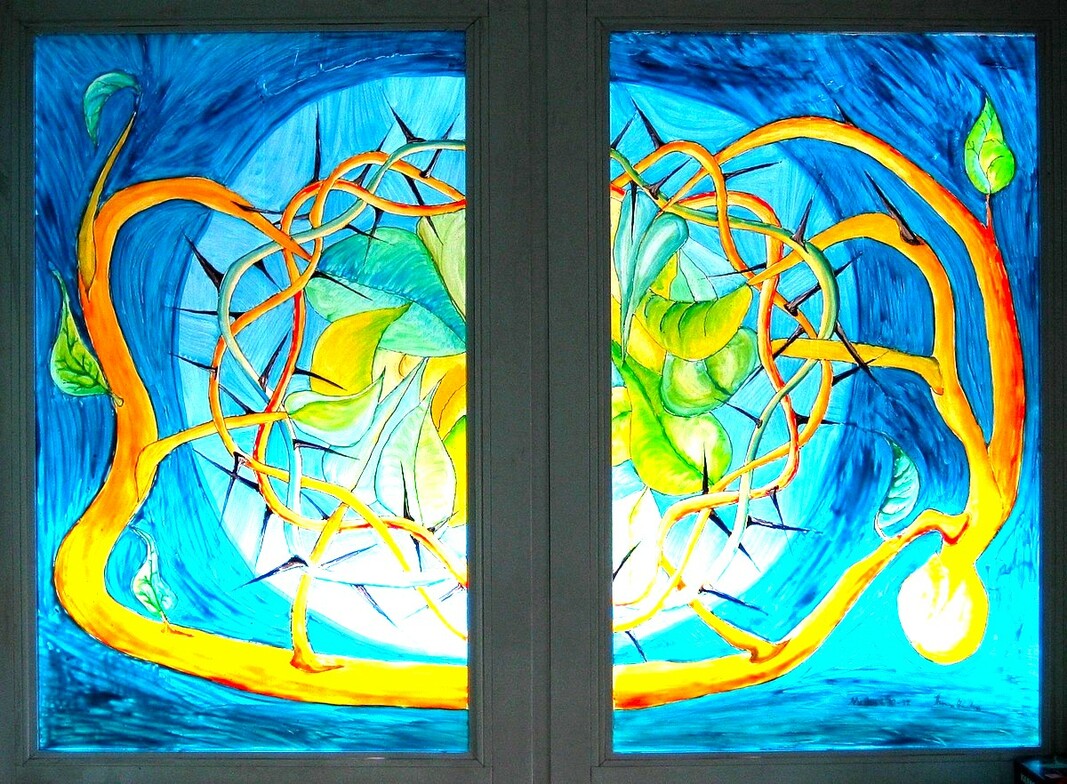
A painted window at the YMCA training center for German leadership in Kassel.
Homily by Rev. Trish
Pentecost 9 Year A
26 July 2026
Matthew 13. 31-33, 44-52
The Parable of The Mustard Seed
Jesus uses some unlikely metaphors for God’s kingdom — we encounter one of these metaphors this morning in the parable of the mustard seed.
I have heard plenty of cute sermons over the years about the parable of the mustard seed talking about how God takes little seeds and makes big trees out of them, but I think there’s much more than that is going on here.
Matthew strategically places the mustard seed parable in the middle of a story about gardening, in which Jesus commands people not to tear up the weeds from the garden but to let the wheat and weeds grow together.
Then, he tells his listeners that the kingdom of God is like mustard.
Mustard grows like a wild bush and can vigorously take over an area. Rather unassumingly, it can blanket entire mountainsides, smother trees, and crack roads and buildings. The mustard seed’s growth would have been familiar to first-century Jews, and its symbolic meaning unmistakably clear. Indeed, it may very well have been growing in the wild around them as Jesus spoke.
When those first-century Jewish peasants heard Jesus’ comparison of the Kingdom of God to Mustard they would have been either flummoxed and amused, or shocked and scandalized. Jews valued order and had very strict rules about how to keep a tidy garden, and one of the secrets was to keep out mustard. It was notorious for invading the well-kept crops and quickly taking over the entire garden. Mustard was regarded as such a threat that Jewish law even forbade planting mustard in the garden.
How then could the Kingdom of God be compared to what was regarded as a noxious weed?
How could the Kingdom of God be compared to something that the law forbade?
Underlying this apparently sweet little story about the tiny mustard seed growing into a mighty tree, is a revolutionary message—a revolutionary message that challenges the widely accepted assumptions of the times.
When Jesus compared the Kingdom of God to the Mustard seed, he uses this infamous plant to describe how God’s kingdom subtly takes over the world.
Plenty of people had lofty expectations of the kingdom coming in spectacular triumph. Mustard hardly compares to the mighty cedars of Lebanon spoken of by the prophets as an image of the triumph of Israel. But Jesus ridiculed this triumphal expectation. The Jesus revolution is not a frontal attack on the empires of this world. Rather it is like mustard—something that slowly spreads and gradually takes over—and which, once it takes root, cannot be easily stopped.
Mustard has always been known for its fiery pungency and strong flavour. For mustard’s flavour and aroma to be released, however, it must be crushed. In comparing the Kingdom of God to mustard, Jesus turns the notion of power on it its head.
His (Jesus) power was not in crushing, but in being crushed — triumphing over the empire’s sword with his cross. Mustard must be crushed, ground, broken — so that its power can be released.
In John’s Gospel, Jesus compares his death and resurrection to a seed that is broken: “Unless a kernel of wheat falls to the ground and dies, it remains only a single seed. But if it dies, it produces many seeds.” (John 12. 24)
This, of course, was not the message of deliverance that people wished to here—yet this is the mystery that we celebrate — a Christ whose body is torn apart and whose blood is spilled like the grains and grapes of the Eucharist that give us life.
Mustard was also known for healing. It was rubbed on the chest to help with breathing, sort of like ‘Vicks VapoRub’. Jesus, like mustard, is a healing balm — it is only when we apply Jesus to ourselves that we find the soothing salve that heals our wounds and makes us healthy and whole. As builders of the Kingdom, we too are called to go out into the world as healers who provide comfort and compassion for the afflicted.
In the parable, Jesus says that “the birds come and perch in its branches.” Another aspect of the popular Hebrew imagery of the cedars of Lebanon is that the nations can build nests in the branches of the cedars. But Jesus puts an interesting spin on it when he says the “fowls” can come and rest in the branches of the mustard bush.
The word fowls is not a reference to the mighty eagles that dwelt in the cedars but (rather) to the detestable birds, the ones that ate animal carcasses.
Farmers did not want fowls in their gardens. That’s why they put up scarecrows.
The Kingdom of God, Jesus wryly asserts, is for the birds, but not any birds—not the birds that represent power and might—but the undesirables—those despised and rejected by the world.
The image of the mustard seed speaks to the mission of the Church in the world—although the Church, like mustard, is often rejected and reviled, it is to go on and patiently persist in spreading God’s Word and building the kingdom of God—a Kingdom not of visible power and might—but a Kingdom of healing and wholeness—that reaches out and provides shelter to all—especially the despised and the rejected.
Amen.