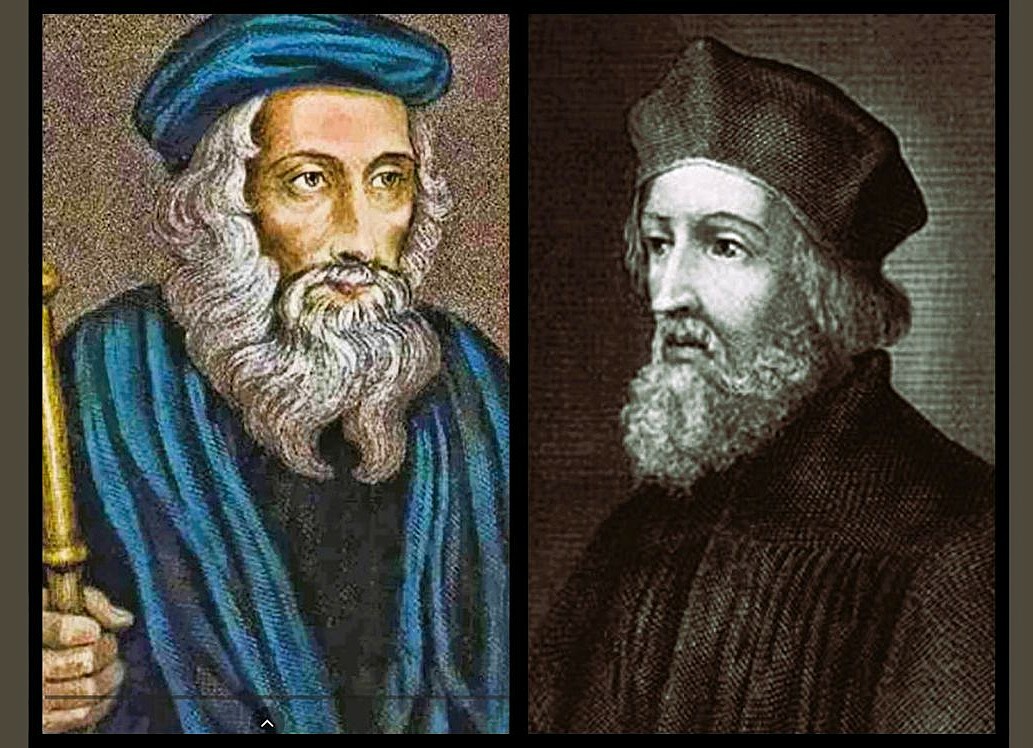
John Wycliffe & Jan Hus,
Reformers
Friday Focus, 30 October 2026
John Wycliffe & Jan Hus, Reformers
Today the church remembers two 14th century reformers, John Wycliffe and Jan Hus.
The fourteenth century was a difficult time for much of Europe. During five years in the late 1340s and early 1350s the Black Death killed no less than two-fifths (and probably more) of the population of Western Europe, upending society there and helping to give rise to the modern world.
The tumult of that time called authorities and institutions into question as, many peasants revolted, many urban workers asserted their rights, and the Church restaffed with substandard personnel.
The Babylonian Captivity of the Papacy (1309-1377) at Avignon, France, caused great scandal as did the Great Schism of the Papacy (1378-1417). Such self-inflicted wounds called the legitimacy of the Church into doubt in the minds of many people.
John Wycliffe lived during those times.
Born near Richmond, Yorkshire, England, circa 1320, Wycliffe was a priest and an academic at Oxford University. He matriculated at Balliol College in 1344 and by 1360 was master of the college. Wycliffe was a popular lecturer and preacher. Towards the end of his life, he became a champion of reform in the life of the church.
Wycliffe became convinced that in terms of both doctrine and life, the Church had strayed from its apostolic roots. He argued that the clergy should not hold secular power, so no Pope should exercise power over the English Church.
Furthermore, Wycliffe wrote, Christ is the sole Head of the Universal Church, the Bible is the Law of God, and the true Church consists solely of the predestined Elect.
Wycliffe also:
-
affirmed the priesthood of all believers,
-
questioned the theology of purgatory and transubstantiation,
-
opposed the veneration of relics and statues,
-
inveighed against the invocation of saints,
-
criticized the celibacy of the clergy, and
-
insisted that the state (with the monarch as the head of the state church) had an obligation
to seize church lands for the benefit of the poor.
Wycliffe alarmed Popes, bishops, and leaders of religious orders, but had protectors in the royal family and among the nobility.
Nevertheless, after he became a scapegoat for a peasant revolt and Oxford authorities declared him a heretic in 1380; forced retirement became his fate. Wycliffe was fortunate: he got to live and to retain his church positions. He died three days after a stroke at Lutterworth on December 31, 1384. Wycliffe was about 64 years old.
Wycliffe’s legacy continued, however. The translation of the Bible into English was a project in which he was deeply involved, with help from others.
Wycliffe's theology influenced contemporaries such as Jan Hus, and later reformers such as Martin Luther, and John Calvin.
The man died, but his ideas lived.
Nevertheless, the Council of Constance condemned Wycliffe as a heretic posthumously in 1415. Thirteen years later, Richard Fleming, Bishop of Lincoln, ordered the exhumation and burning of the old priest's remains.
Jan Hus, born in Husinec, Bohemia, in 1371, was 17 years old when Wycliffe died.
Hus, influenced by Wycliffe’s writings, became a reformer in Bohemia and walked the road to martyrdom.
Hus, educated at the University of Prague (starting in 1390) was a Roman Catholic priest, as Wycliffe had been. Hus, based in Prague, was, from 1392, chaplain of the Bethlehem Chapel, where he preached in the Czech language. He became the dean of the philosophy faculty of the University of Prague in 1401 and served as the Rector of the university from 1403 to1409.
The following year, however, Archbishop Zbynek Zajic of Hasenberg excommunicated Hus.
Hus had been reading, marking, learning, and inwardly digesting writings of Wycliffe, as well as translating some of them into Czech.
Wycliffe’s ideas had already begun to influence politics in Bohemia, where the Church owned about half of the land, and many people, including a large number of priests, were poor. Many peasants resented the Church, for obvious reasons.
Hus condemned ecclesiastical abuses and defined the true Church as the assembly of the predestined Elect. Like Wycliffe, royal protectors enabled Hus to continue teaching and preaching. When John XXIII, ** one of the three persons claiming the chair of St. Peter at the time, threatened to launch a crusade against the Czech King for protecting heretics, the King withdrew his support from Hus.
Hus fled to southern Bohemia but was arrested and put on trial as a heretic. He was burned at the stake at the age of 43 on 6 July 1415.
The story of Wycliffe and Hus reminds us that from time-to-time God calls up leaders to challenge the Church and recall it to its foundational purpose and mission.
While one might disagree with Wycliffe and Hus on certain political and/or theological points, one should recognize and respect their courage in risking their lives by resisting authority nonviolently in the knowledge that the authorities they objected to had the power to torture and execute them.
Unfortunately, the Church, blinded by wealth and power and the weight of unexamined custom and tradition, has sometimes silenced and killed its prophets. May we be willing to hear the prophets of our own day who call the Church to reform so that it might carry on its mission of love, peace, and justice for all people more fully.
Norman+
**John XXIII is now considered to be an antipope and
Gregory XII's reign is recognized to have extended until 1415.
Image:
John Wycliffe & Jan Hus