June 21 2026 National Indigenous Day of Prayer
A message from Archdeacon Rosalyn Kantlaht'ant Elm: The Treaty of The Dish with One Spoon

Christina (Tina) McKinlay
June 18, 2026
- News
- June 21 2026 National Indigenous Day of Prayer
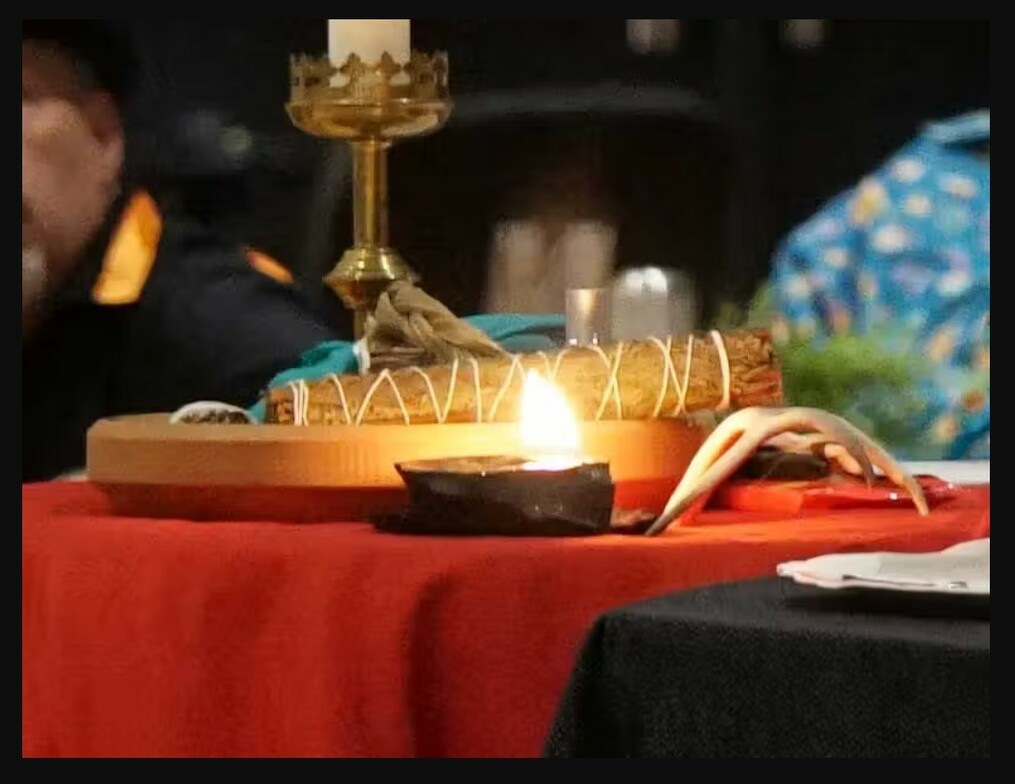
The Treaty of The Dish with One Spoon
Hello Everyone.
My name is Roslin Gunlan Elm, and I am the Director of Indigenous Ministry for the Anglican Church of Canada. It's good to be with you here the Diocese of Kootenay. I can see you out there.
Thank you Bishop Lynn for inviting me to speak today, on this Indigenous Day of Prayer.
I think I want to begin with telling you a different kind of gospel, a gospel of a story that my father told me about the oldest treaty that we know. The oldest treaty that we know in the in in the east anyway. It's called ‘The Dish With One Spoon’.
The Dish With One Spoon is more than a treaty. It is a way of understanding how human beings are meant to live with one another. It teaches us that the land is a gift. It's not ours to possess as individuals. They are gifts entrusted to all who share in the lands and territories in the earth.
We eat from one dish because we share one territory, one land, one creation, and ultimately one life.
And when my father first explained it to me, I asked a simple question. “Why didn’t they call it ‘A Dish With Many Spoons?’” To me, it seemed more practical. If everyone had their own spoon, then everyone could simply take what they wanted.
Well, my father, he smiled and he said, "Well, that is the problem." And I thought for a moment and I said, "Wouldn't it be easier?"
“Yes,” he said “it would be easier, but that's not how we share and that's not how we live.”
The wisdom of The Dish With One Spoon is that it places limits on an individual. It places limits on our consumption and reminds us that our responsibility is to one another.
If there was only one spoon, we must pay we must pay attention to one another. We simply cannot take what we want. We must ensure that everyone has enough.
The question is not, “How much can I take?”
The question becomes, “What does my neighbor need?”
That teaching runs against much of what we are taught in this culture. We're often taught to ask questions of ownership, of entitlement, and of personal rights.
“What belongs to me? What have I earned? What do I deserve?”
But The Dish With One Spoon has something different.
Who else is at our table? Who has been left out? And who's hungry? How do we ensure that everyone has enough? How do we ensure that everyone has enough to flourish?
It's a teaching that's grounded in relationship, reciprocity, and responsibility.
In many ways, it echoes the vision that we find throughout scripture.
In the Book of Acts, the early Christians shared the resources so that there was not a needy person among them. Their concern was not the individual or individual accumulation, but ‘communal well-being’. The health of the community mattered more than the wealth of the individual. They understood that what they possessed was ultimately a gift of God and that gifts are meant to be shared.
The same principle appears throughout Indigenous traditions.
Well-being is not understood as primarily as individual achievement. It's relational. We flourish together or we suffer together.
The health of the people, the health of the land, and the health of future generations are inseparable.
And this wisdom always begins with gratitude and the Word, before all else.
Gratitude is far more than saying, “Thank you.”
Gratitude is a way of seeing the world.
It recognizes that Life itself is a gift.
Because none of us created the air we breathe. None of us created the earth beneath our feet. And none of us created the waters that sustain life.
And none of us created the people who loved us into existence.
Everything begins as gift.
When we truly recognize this, our relationship with the world changes.
Gratitude opens our eyes to abundance. We begin to see how much we have received, rather how much we lack. And abundance, of course, always leads to responsibility.
When we recognize life as a gift, we become more attentive to others. We begin to ask how we might share in what we received.
Gratitude becomes generosity. Thanksgiving becomes ownership. And blessing becomes responsibility.
And maybe that's the lesson of Father's Day.
Wisdom is not simply about accumulating, or accumulating knowledge or experience.
Wisdom is about learning how to widen the circle of care.
'A good Dad' is not measured by how much he possesses, but by how many people flourish because of his presence.
As we grow older, our calling is not to build higher walls amongst ourselves.
Our calling is to draw the circle wider.
The movement of widening the circle is one of the greatest themes in scriptures. That act of moving from the particular to the universal. Again, and again God's covenant expands outward.
The stranger is welcomed. The widow is protected. The Biblical Story is not one of exclusion but of ever-expanding Belonging.
And Jesus embodies this movement throughout his ministry.
He eats with those considered to be ‘less-than’: tax collectors, sinners. He touches that those that are considered to be unclean. He speaks with the Samaritans. He heals Gentiles. He welcomes little children. He restores those whom society has cast aside.
Again, and again Jesus crosses boundaries, draws the circle wider.
He refuses to allow social divisions, refuses ethnic divisions, refuses religious divisions or moral divisions. He welcomes everyone into his circle: everyone into the circle of God's love.
The Kingdom of God is always larger than we can imagine.
The vision helps us understand what Paul is saying in Philippians.
When he's in prison, he writes under difficult circumstances here. He has every reason to be angry, anxious, discouraged, and resentful. But instead, Paul begins with joy.
“Rejoice in the Lord always”, he says. Before addressing conflict, he calls the Church to gratitude. Before confronting fear, he calls the Church to prayer. Before speaking about what is broken, he reminds them of what has been given.
The remarkable thing about Paul's teaching is that gratitude is not dependent on circumstances.
Paul is not grateful because life is easy. He's grateful because God's presence remains faithful and steadfast — even in hardship. The faithful God.
For Paul, thanksgiving is not denial. It's trust.
Gratitude reminds us that we belong to something larger than ourselves. It reminds us that God's faithfulness is greater than our fears. And when communities are shaped by gratitude, peace becomes possible.
The peace Paul describes is not simply an inner feeling. It is a peace that emerges when people stop competing for scarcity and begin living from abundance.
It is the peace that grows when people trust one another. When we become vulnerable with one another. When we can care for one another enough to just share, just share without thinking.
It is a peace that comes when communities recognize that they are bound together by relationships and of care.
So, this brings us today to our work of Reconciliation.
Too often, Reconciliation is understood primarily as the settlement of grievances, the resolution of conflict, or the correction of historical wrongs. (I almost lost my computer there.)
But these things do matter. Truth matters; justice matters; repentance matters; repair matters.
But Reconciliation is ultimately about something larger.
Reconciliation is about drawing the circle wider. And this circle imagery is deeply significant.
A circle is a place of relationship where no one is above one another, where no one is ahead of one another. The circle is a place of responsibility and it's a place of belonging.
To draw the circle wider is not simply to add more people to an existing arrangement but is also to create a new way of living together.
It is to create a community in which more people can participate. There is more shared life; more shared responsibility; and more shared flourishing.
This understanding moves Reconciliation beyond guilt into obligation. And we want to move beyond guilt and obligation.
If Reconciliation is only going to be driven by guilt, then it becomes defensive.
If Reconciliation becomes only driven by obligation, it becomes transactional.
But when Resurrection/ Reconciliation is rooted in community and gratitude and hope, it becomes an active invitation.
It asks not how we address the wounds of the past. It asks how do we create a future in which more people can belong, in which we can care for each other than the wounds that exist.
This is why Reconciliation isn't about looking backward. It's about looking forward.
The goal is not simply to heal old wounds, but it's to build something new, to generate new relationships.
The goal is not simply to acknowledge harm, but it's to create a bigger ‘we’, a bigger ‘us’, a bigger community, a wider community.
The goal is not simply to coexist with one another.
But it's about walking together, sojourning together – because none of us want to be settlers.
This vision, this vision of flourishing is one that is urgently needed today.
We live in a world that is increasingly marked by division. Political divisions, economic divisions, cultural divisions, social divisions — tempt us to retreat into smaller and smaller and smaller circles — where we are encouraged to protect only our own interests. Defend only our own identities and fear those who are different from us.
But the Gospel offers another way. The Gospel invites us to imagine a larger table.
The Dish With One Spoon asks us, and reminds us, is there enough? There is enough.
There's always enough when we learn to share.
Now Paul reminds us that gratitude opens the door to peace.
Jesus reminds us that the circle of God's love is wider than we think.
And Reconciliation reminds us that our future depends on learning how we belong to one another.
The work continues by remembering that we are already 'Creators', that we belong to 'Creation'.
It continues through truth-telling, justice, repentance, and repair. But it reaches its fulfillment when more people are welcomed into the circle of life.
May we be a people of gratitude. May we be a people of generosity. May we be a people of reconciliation. May we sojourn and not settle.
May we have the wisdom and courage to keep drawing the circle wider until everyone has a place at the table and we can all share in The Dish With One Spoon.
I want you to all have a wonderful day.
Keep sharing with your family and your friends and your community. Drawing that circle ever wider in peace.
Amen.