Homily 27 September 2026
What Truth and Reconciliation Asks of Us

Christina (Tina) McKinlay
September 28, 2026
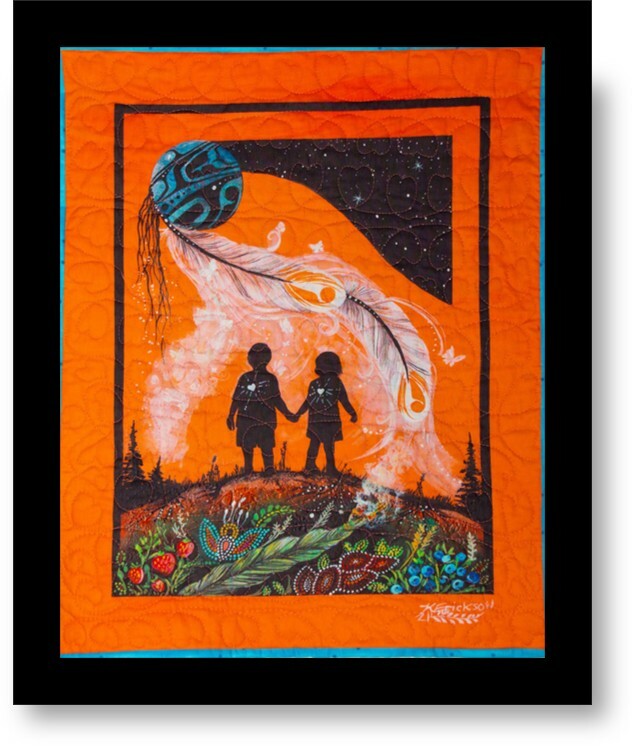
'The Journey Home'
What Truth & Reconciliation Asks of Us
In the name of the Father, and of the Son, and of the Holy Spirit. Amen.
Today we gather on the National Day for Truth and Reconciliation.
We gather to remember.
We gather to listen.
We gather to acknowledge a painful part of our history.
And we gather in prayer, in humility, and with a willingness to allow the truth to change us.
I am wearing a stole today that I made myself, and which was blessed by my dear sister in Christ, the Reverend Sheila Cook.
That makes this day particularly personal for me.
Four years and just a few days ago, I was ordained alongside my beautiful sisters, Sheila and Kirsten. We were smudged at the opening of Christ Church Cathedral in Victoria, and I remember being completely in awe of the beauty of creation and of the Indigenous nature of that worship space.
I remember feeling deeply connected to God in that moment.
And I remember the words and challenge that accompanied our ordination.
On that day, Rev Dr. Ray Aldred, Director of Indigenous studies at VST spoke about the calling of the diaconate. He spoke honestly about a Church whose good news has sometimes been overshadowed by the shortcomings of the Church itself.
He reminded us that the Church can be tempted to become too concerned with institutions, structures and power—to imagine itself as an earthly kingdom rather than remembering the humility of the cross.
And he reminded us that the calling of a deacon is not a calling to status.
It is a calling to service.
To go out. To listen. To see. To stand alongside people.
To carry the Gospel into the messy places where people are hurting.
That message has stayed with me.
Because if we are serious about following Christ, then we cannot simply proclaim God's love while looking away from the places where people have been wounded.
We have to be willing to look.
We have to be willing to listen.
And sometimes, we have to be willing to look honestly at the history of the Church itself.
That is part of what Truth and Reconciliation asks of us.
During the 'Salt of the Earth' retreat, Bishop Anna referenced Chris Arnett's book, The Terror of the Coast: Land Alienation and Colonial War on Vancouver Island and the Gulf Islands, 1849–1863.
It is a difficult book to read, particularly for those of us privileged to live in this beautiful part of God's creation.
It reminds us that the places we know today by colonial names were not empty places waiting to be discovered. They were already home to complex, beautiful and established Indigenous Peoples and Nations.
The names of gunboats became the colonial names of islands and waterways that had long been known by Indigenous names.
Alert Bay: 'Yalis. YAH LEEZ
Ganges Harbour: Sherawat and SYOWT. SHE YA WIT
Thetis Island: Stu'kin. STEW KIN
It is taking us a long time as settlers to learn the original names for these places.
And perhaps that is because it is also taking us a long time to face the violence of our own history.
We have sometimes acted as though these lands were empty before Europeans arrived—as though there was nothing here to disrupt, nothing here to lose.
But there were people here.
There were families.
There were communities.
There were languages and cultures.
There were relationships to land that stretched back generations upon generations.
And there was violence. There was the taking of land. There was the disruption of communities. There was the suppression of languages and cultures.
And there was the forced removal of children through residential schools.
Families were separated.
Children suffered.
Some never came home.
And the consequences of that history did not simply disappear when the residential schools closed.
That is why Truth and Reconciliation requires more than remembering a terrible chapter in Canadian history.
It requires us to ask what that history has left behind.
It requires us to ask who is still carrying the wounds.
And it requires us to ask what our faith demands of us when we know that our neighbour has been wounded.
Which brings us to our Gospel story from last week.
At first, Matthew's parable of the labourers in the vineyard may seem like a strange Gospel for a day of reconciliation. Especially since it was last weeks gospel reading but it is very fitting
There are workers hired early in the morning.
Others are hired at nine.
Others at noon.
Others at three.
And finally, there are people hired at five o'clock—only an hour before the working day ends.
At the end of the day, the landowner pays them all the same.
And the workers who came early are angry. They believe it isn't fair. They worked all day. Why should those who came at the last hour receive the same?
And Jesus asks them:
“Are you envious because I am generous?”
That question takes us to the heart of the parable.
But there is another detail that I think is especially important.
When the landowner finds the people who have not yet been hired, he asks why they have been standing there all day.
And they answer: “Because no one has hired us.”
They are standing outside the vineyard. Not necessarily because they didn't want to work. Not necessarily because they were lazy.
They were standing outside because no one had invited them in.
And suddenly the parable becomes a powerful story for reconciliation.
Because we have to ask: Who is still standing outside?
Who has been waiting? Who has not been heard? Who has been overlooked?
Who has been pushed to the margins?
Who has been made to feel that there is no place for them?
When we speak about Indigenous peoples in Canada, we cannot pretend that everyone has experienced Canada's history in the same way. We have not.
Indigenous peoples have experienced loss of land, disruption of community, suppression of language and culture, and the devastating effects of residential schools.
And those experiences have consequences that continue across generations.
This is also part of the story behind the disproportionately high rates of suicide experienced in some Indigenous communities.
Statistics Canada has found that suicide rates among First Nations, Métis and Inuit peoples have been substantially higher than among non-Indigenous people. Among First Nations people in the period examined, the suicide rate for males was particularly high, and among Inuit the disparity was even more severe.
But we must be very careful about the story we tell when we talk about these statistics.
Suicide is not an inherent characteristic of Indigenous people.
Indigenous men and boys are not somehow destined for despair.
The statistics are not a statement about the value of Indigenous lives.
They are a sign of suffering.
And research points to many contributing factors: historical and intergenerational trauma, the loss of family, language, culture and community connections, poverty and socioeconomic disadvantage, limited access to mental-health and culturally appropriate services, social isolation and discrimination, and, for some men, difficulty asking for help or expressing emotional pain.
This brings us back to the vineyard.
Because when we speak about Indigenous men and young people experiencing despair, perhaps we should not ask: “Why didn't they make it into the vineyard?”
Perhaps the better question is: “Why were they left standing outside?”
That is a very different question. It moves us away from blame and toward responsibility.
It asks us to notice. It asks us to listen.
It asks us to consider what happens when people experience generations of being told, directly or indirectly, that there is no place for them.
And Jesus asks us to notice them. He asks us to notice the people who are still standing outside. The people who have been overlooked. The people whose stories have not been heard. The people whose dignity has been denied.
And then Jesus asks us to make room.
That brings us to another important part of this parable: fairness.
We often think fairness means that everyone receives exactly the same thing.
But the workers in the vineyard did not have the same experience.
Some worked all day. Some worked part of the day. Some stood waiting because no one had hired them. They were not starting from the same place.
And that matters when we talk about reconciliation.
Because treating everyone exactly the same is not necessarily justice.
Sometimes justice means recognizing that people have experienced very different things and responding to those differences with compassion, dignity and generosity.
That is what makes the anger of the early workers so challenging.
They believe that generosity toward someone else diminishes what they themselves have received. But Jesus challenges that thinking.
When dignity is restored to another person, our dignity is not diminished.
When another person's story is finally heard, our story does not become less important.
When Indigenous children are taught that their language and culture are gifts rather than things to be ashamed of, our children lose nothing.
When justice is extended to someone who has experienced injustice, we do not become poorer.
The vineyard becomes larger. The community becomes stronger. And the kingdom of God becomes more visible.
Perhaps that is one of the great challenges of reconciliation.
We are being invited to move from: “What do I have to give up?”
to: “What can I do to help another person flourish?”
That is a very different way of seeing the world. And it is a very different way of understanding the Gospel.
Because Truth and Reconciliation cannot simply mean saying that everything is now fine. It cannot mean remembering the past once a year and then returning to business as usual.
Reconciliation begins with truth.
And the Church must be willing to acknowledge its own part in that history.
We cannot proclaim Christ's love while refusing to recognize where Christians and Christian institutions participated in harm.
That is not condemnation. It is honesty.
And honesty is necessary for healing.
Because you cannot reconcile what you refuse to acknowledge.
So today we listen. We listen to survivors. We listen to Indigenous elders. We listen to Indigenous communities. We listen to families who continue to carry grief across generations.
And we listen without immediately trying to defend ourselves.
Sometimes the most loving thing we can say is simply:
“I hear you.”
“Your story matters.”
And then:
“What can I do now?”
Because the parable does not leave the workers standing outside the vineyard forever.
There is work to do.
And I believe that is where the Gospel leaves us today.
There is work to do.
Reconciliation is work. Learning is work. Listening is work. Building relationships is work.
Confronting racism is work. Remembering is work.
And sometimes reconciliation is uncomfortable work.
But Christians should not be afraid of uncomfortable truth.
Jesus never was.
Jesus continually challenged people to see the world differently. To see the person others ignored. To welcome the person others rejected. To love the person others found difficult.
And to recognize that every human being is created in the image of God.
So perhaps the question for us today is not:
“Who deserves to be in the vineyard?”
Perhaps the question is:
“Who is still standing outside?”
Who is still waiting? Who has not been heard? Who has been forgotten? Who has been made to feel that they don't belong?
And what are we willing to do about it?
Because the vineyard is God's. Not ours. The workers don't own it.
The landowner does.
And if the vineyard belongs to God, then we are not the ones who get to decide who is worthy of God's love, dignity and welcome.
Our task is to help cultivate the vineyard. To make it fruitful. To make it welcome. To make it a place where God's justice and mercy can grow.
And today, I think of my dear sister Sheila. I think of the stole she blessed. I think of the day we stood together at our ordination. And I think of the grief she carries in the loss of her son.
There is no easy theological answer to the loss of a child.
There is no sermon that can make that pain disappear.
But perhaps there is something we can say. We can say that his life mattered. We can say that his story matters. We can say that his family matters.
And we can say that grief should never have to be carried alone.
Today we remember those who suffered.
We honour survivors.
We remember the children who never returned home.
We remember families and communities carrying grief across generations.
And we commit ourselves to listening and learning.
But we also remember that the Gospel is ultimately a Gospel of hope.
The story does not have to end with the past. God is still working in the vineyard.
And perhaps God is calling us to join that work.
Not by pretending the past did not happen. Not by feeling guilty and then walking away.
But by allowing the truth to change us.
By allowing compassion to change us.
By allowing relationship to change us.
And by allowing God's generosity to change the way we see one another.
The workers in the vineyard discovered that God's idea of fairness was bigger than theirs.
Perhaps we are being asked to discover the same thing.
God's justice is not about keeping everyone at exactly the same place.
It is about making sure that everyone has a place.
Everyone has dignity. Everyone has a voice. Everyone is seen. Everyone is valued.
And everyone is invited into the work of God's kingdom.
So today, may we have the courage to tell the truth.
May we have the humility to listen.
May we have the generosity to make room.
May we have the courage to do the work of reconciliation.
And may we remember that when we make room for another person in God's vineyard, we do not make the vineyard smaller.
We make it more like the kingdom of God.
Amen.