Homily, November 15, 2026
We Are Called to Live by Trust, Hope, and Love

Christina (Tina) McKinlay
November 16, 2026
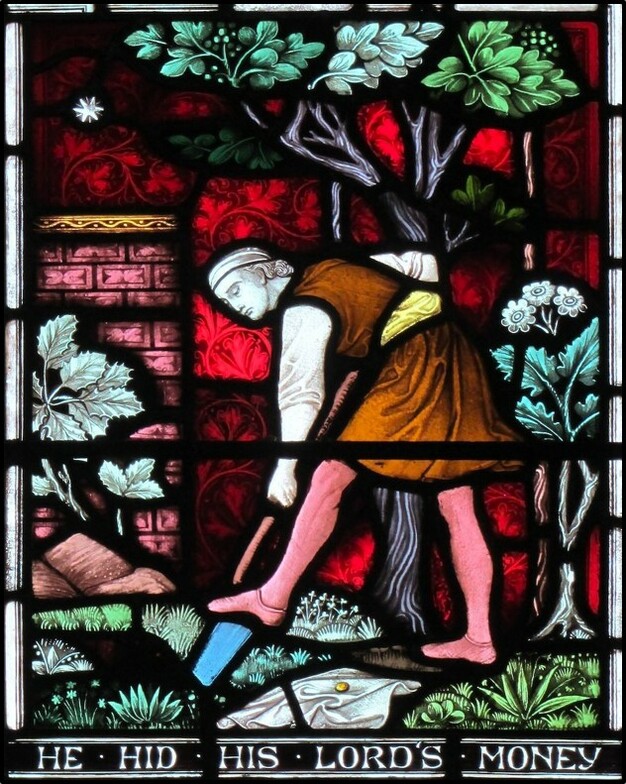
He Hid His Lord's Money
Pentecost 25 Year A 15 November 2026
Judges 4:1-7; 1 Thessalonians 5:1-11 Matthew 25:14-30
We Are Called to Live by Trust, Hope, and Love
The three primary virtues, as proclaimed by St. Paul, are trust, hope, and love.
But it seems so much of our public discourse today reflects the opposite of these things. The internet is filled with misinformation and dubious claims of miraculous products to solve all our problems. All too often, social media is a forum for anonymous hate speech.
In a world of competing ideologies, too many of us isolate ourselves from others and live in echo chambers -- where we only hear what we want to hear. We divide the world into us and them, heroes, and villains. In such a world, we begin to distrust our institutions.
We argue about the ‘facts’ and question the existence of ‘truth’ altogether. In such a world, nothing matters and anything goes.
We put our politicians on pedestals, only to knock them off when a problem arises, or when they show that they, like us, have human flaws. We even rewrite history when the great leaders of the past are revealed to have been simply people of their own time and place.
We demand perfection of others while refusing to admit to our own shortcomings.
In a world such as this, cynicism replaces trust, hope gives way to despair, and love loses out to and hatred of ‘others’ — whoever those ‘others’ may be. Not surprisingly, many of us cry out: “Stop the world! I want to get off!”
Despair, nihilism, and terror go hand-in-hand.
So what do today’s readings say to us, here and now?
In the reading from Judges, the people of Israel, at war with their Canaanite neighbours, have been cowed by the military might of Sisera — the Canaanite commander. But Deborah the prophetess urges them to take heart and go to battle against him, saying God will give them victory.
We have here both an encouragement to trust in God, but also a troubling example of how easily we treat God as a ‘tribal deity;’ claiming God as our own and using him to lord over others and justify our own privileged position. More on this later.
Paul’s First Letter to the Thessalonians continues the theme of ‘waiting on God’ which was also part of last week’s readings. Then as now, as these early Christian communities waited for the return of Christ and the ‘end of the age’ with its accompanying theme of judgment, many grew impatient – and the attractions of the world provided both a diversion and a temporary escape from the troubles of everyday life.
But Paul reminds them that they are children of the light and, even if no one knows when Christ will return, they are to be awake, alert, and ready to welcome him. To be awake, alert, and ready to welcome God requires that we live the primary virtues proclaimed by Paul — that we be beacons of trust, hope, and love in a dark world.
In Matthew’s gospel, belief in Christ’s return and a ‘last judgment’ is also present.
Jesus’ parable of the talents explores this theme, saying in effect, “Look, God has given each and all of us different gifts, and we are ALL expected to use them well, and be accountable for them.”
The message is clear: use it or lose it.
The parable is not (as some have claimed) an endorsement of the so-called ‘prosperity Gospel’ that champions financial success and sees it as a sign of God’s blessing. Jesus constantly reminds us that his way is different from the ways of the world: that his way is not the way of power and might but of service and sacrifice.
The parable of the talents does not provide a sanction for the accumulation of wealth, but rather, a call to use the gifts that we have been given, to help build up God’s kingdom of peace and justice. We will be judged — not by our material success and worldly power — but by how we used the gifts God has given us, for the betterment of all.
So, what does it mean to be trustees of God’s gifts to us?
First, we need to be clear about what kind of God we believe in.
In the biblical narrative, God is sometimes portrayed as a ‘tribal deity’ who plays favourites and goes to battle for “his people.” We often revert to this idea, seeing God as “my God” or “our God against yours.” But the great prophets of the Hebrew scriptures (and of course Jesus himself) are clear that God is no one’s possession, and calls us to do justice, love kindness, and walk humbly.
Jesus identifies, not with the powerful, but with the least — dying an agonizing death on a pole used to display the cruel power of empire, and to show empire’s contempt for any who challenge it.
But Jesus shows that love and compassion are stronger than any empire and invites us to follow in his way.
The basic talents God has given us are precisely those gifts of trust, hope, and love of which Paul speaks — and we are to nurture and use them so that they grow and spread and build up God’s kingdom here on earth.
Today’s readings remind us that we are ‘children of light’—called to live by trust, hope, and love. Knowing there is no peace without justice, and no justice without peace, we are called to work for both — using whatever gifts we have been given.
For these gifts and talents of trust, hope, and love, thanks be to God!
Amen.