Friday Focus January 30, 2026
Thomas Aquinas: Patron Saint of Theological Education

Christina (Tina) McKinlay
January 30, 2026
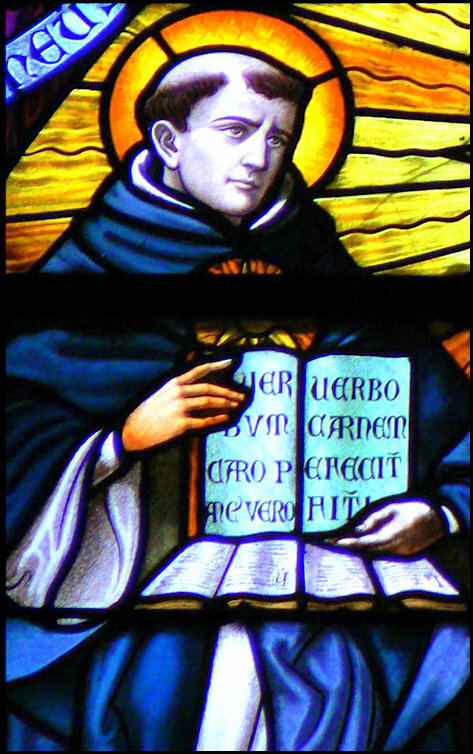
Thomas Aquinas
Thomas Aquinas
Patron Saint of Theological Education
On January 28th we celebrated the life and witness of Thomas Aquinas, a person rightly regarded as the patron saint of theological education.
What does he have to teach us today?
Thomas Aquinas was a Dominican monk. That is to say that he gave up something for something else. He was a person who set aside what was small in order to find something that was bigger—he put aside wealth, ego and physical satisfaction to become a poor, celibate, member of a community.
While most of us are not called to answer God’s call in this way, Thomas reminds us that we have to be poor in spirit in order to possess that which is of real value. We have to die to ourselves in order to live fully. We can believe in God who is one, only if we are prepared to serve and stand alongside the many.
In becoming a monk, Thomas sacrificed much.
A person of noble parentage, he certainly suffered a considerable loss of social status and comfort. And this is true for us today—anyone considering following a vocation in ministry will be required to sacrifice much—not simply material comfort, but status and prestige as well. In our post-Christian society, surveys reveal that those in ministry enjoy a reputation only slightly better than that of lawyers and politicians!
It is worth remembering that Thomas’ choice to become a monk was not a rash or intemperate one. He entered the Dominican order realistically, soberly, and honestly, without any fanaticism and without any unrealistic idealism. Such discernment is necessary, I believe, for anyone attempting to discern God’s call.
Such a balanced temperament shaped Thomas’ contributions as a theologian.
For Thomas, theology was never merely a matter of abstract reflection or philosophical contemplation. Rather for Thomas, theology needed to be clear and accessible, purposeful and practical.
As a theologian, Thomas was acutely aware that if his studies were to mean anything, they must be shared, discussed, and debated—and that it was only through such an exchange of ideas, an exchange based on careful reflection, clear articulation, and attentive listening—that the truth of the Gospel could be proclaimed.
That is what theology is all about.
The theologian must always be ‘sanctified to the truth’ (John 17.17). Theology must never become a self-indulgent exercise whose primary purpose is demonstrating one’s own wisdom, winning an argument, or exercising power over others. No, the theologian must always be ‘sanctified to the truth’.
To be sanctified to the truth is to recognize that all knowledge, all wisdom, is a gift from God; and because knowledge is a gift, it is to be shared.
In the book of Wisdom, we read: ‘I learned without guile and I impart without grudging’
(Wisdom 7.13)
To ‘learn without guile’ means to learn without thought of selfish gain, without cunning design, without ulterior motive—something that sadly seems all too lacking in the current debates that divide and fragment our Church and world.
Those who ‘learn without guile’, teach ‘without grudging’. Those who appreciate that knowledge and wisdom are gifts, willingly share; so that, as Jesus’ states in his high priestly prayer in John’s Gospel, ‘the world may believe.’
Believe in what? Love—simple, generous, unconditional, love.
Thomas studied and taught as one who loved the pursuit of wisdom and truth more than his own subjective, selective curiosity.
At the heart of his theology was the conviction that faith and reason are partners, not enemies.
This idea has come under assault recently in best-selling books by Richard Dawkins and Christopher Hitchens—men who dismiss faith as an irrational and dangerous delusion.
But Thomas demonstrates that faith and reason are not irreconcilable.
He was able to assert his convictions in a far more subtle, nuanced and logical fashion than either Dawkins or Hitchens who classify all believers as the same. This does not mean that we can simply dismiss or ignore Dawkins and Hitchens.
They reflect a powerful current in our contemporary culture that rightfully fears the power of various religious fundamentalisms that define our times.
I would like to share something of my own spiritual journey. I was baptized in Grace Anglican Church, Ilderton Ontario, when I was seven or eight years old.
My parents were not church people, but my grandmother was quite concerned that her grandsons had not been baptized.
My parents believed that this was a decision that we had to make for ourselves. I remember my mom asking me one day if I would like to be baptized. I went away and thought about it and came back to her and said, “yes I would.” Now, I do not remember my reasons at the time, as I said my parents were not church people, but they were moral and ethical people. They certainly instilled within me a respect for others and for creation.
I always remember having a sense of some reality greater than myself—especially on family camping trips. I remember sitting on the beach around a campfire with my parents and brothers at Providence Bay on Manitoulin Island and being in total awe and wonder and certain that there must be a Creator! Such beauty and peace could not simply be an accident! And so, I was baptized and I began going to Sunday School.
This is where the trouble started.
I remember the resentment I felt at being marched out of church into the Sunday school room when the service began and wondering what I was missing and what the adults were doing.
I remember the frustration of my Sunday School teacher (an older well-meaning women) who didn’t know how to answer my endless questions and who came to resent my questioning.
Needless to say, after a few years I stopped going to Sunday school and drifted away from the church until university.
As an undergraduate at Huron College, I had the good fortune to become part of a group of students who were spiritual seekers.
We were all 'out student' which meant that we did not live in residence. We were 'out students' in other ways as well. We did not quite fit into the dominant preppy culture of Huron at the time. Through this this group, all of whom remain close friends to this day, I was exposed to a wide variety of church and spiritual experience--most of which I found either intellectually vacuous, emotionally manipulative, or politically offensive.
I came very close to concluding, like Dawkins and Hitchens above, that if this was Christianity and the Church had to offer, then I wanted no part of it!
Then one cold and grey November, morning I did something I hadn’t done before—I wandered into the chapel.
It was the Feast of All Saints, and a Solemn Eucharist was about to be celebrated. I was immediately struck by the architecture, the warmth and the beauty of this place! George Black’s music was gloriously transcendent! The liturgy had a wholeness and unity that reminded me that I was part of a larger community—here and now but also one that had gone before.
The preaching was intelligent and challenging, unlike most of what I had recently been exposed to, and acknowledged that I had a brain and invited me to use it.
And then, as the celebrant elevated the host, sunlight broke through the windows and a rainbow appeared through the incense hanging over the altar!
At that moment, I experienced the same awe and wonder as I had felt on that beach at Providence Bay. I knew I had found a spiritual home. I knew that faith and reason, mystery and wisdom could indeed be one! And for the first time, Huron’s motto, ‘true religion and sound learning,’ came alive for me.
While Thomas Aquinas was not the first to assert the unity of faith and reason, he went farther than most to demonstrate that unity.
Thomas had the courage to strive for clarity wherever clarity is possible.
He had the courage to bow before mystery, where mystery remains.
He had the courage to challenge the widespread or dominant opinions of the time.
Yet, he never sought the sensational nor made novelty the criterion for truth. He engaged in theological discussion and debate with consideration. He expressed his own opinions without being disputatious or dismissing those with whom he disagreed.
One could disagree, Thomas asserted, without being disagreeable.
Aquinas had the courage to change the views he expressed in his earlier works whenever fuller knowledge or reflection required him to do so.
He treasured the inheritance of the past, but he remained open to everything his own time could bring to him.
Above all, he wrote in humility because he knew that he spoke of a God beyond everything theology could say! He spoke of a God greater than any question he could ask, any response he could ever imagine!
Thomas knew what it meant, in the words of 1 Corinthians, to ‘know only in part’ and to ‘see in a mirror dimly.’ He knew and experienced so much that in the end he substituted silence for words! He ceased to write and considered all that he had written to be but ‘straw.’
He became silent because he wanted to let God alone be heard.
We may no longer hold onto to all of Thomas’ ideas, he remains a model for us of ‘how to do theology’ and ‘how to think theologically.’
Paul writes: ‘When I was a child, I spoke like a child, I thought like a child, I reasoned like a child; when I became an adult, I put an end to childish ways.’
1 Corinthians 1.11
As students of theology, may we, like Thomas Aquinas, ‘put an end to childish ways’ – ways that are self-centred and self-serving.
May we be ‘sanctified in truth.’
May we dedicate ourselves to the pursuit of faith and reason, the unity of love and wisdom, and in so doing incarnate ‘true religion and sound learning.’ Amen.
Norman+