Friday Focus February 27, 2026
George Herbert, Priest and Poet

Christina (Tina) McKinlay
February 26, 2026
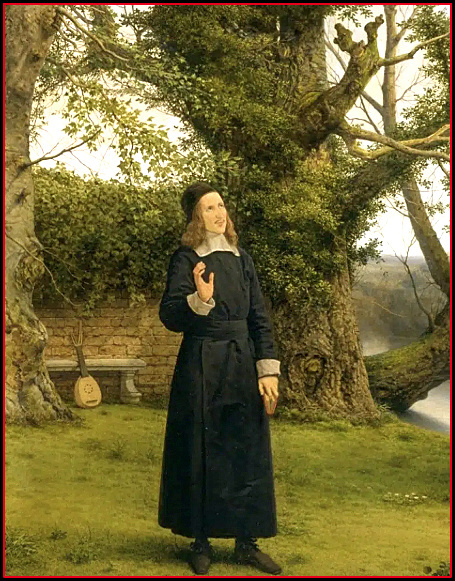
George Herbert at Bemerton
George Herbert, Priest, & Poet
“Whatever you do, work at it with all your heart,
as working for the Lord, not for human masters…
It is the Lord Christ you are serving.”
Colossians 3. 23-24
On this day (Feb. 27), the Church celebrates the life and witness of George Herbert.
Imagine a man of immense talent, educated at Cambridge, fluent in Latin and Greek, admired in the royal court — yet he turns away from political ambition to serve a small rural parish. No fame, no fortune, no worldly power — just a humble church in Bemerton, England, and a heart wholly devoted to God.
George Herbert (1593–1633) was such a man— poet, priest, and one of the most luminous voices in Christian devotion. His life reminds us that greatness in God’s kingdom is not measured by the size of our platform, but by the depth of our faithfulness.
Herbert’s early life was marked by privilege and promise. He was a brilliant scholar, a gifted orator, and destined — many thought — for political greatness.
But God had a different plan.
When Herbert left the halls of power for the quiet fields of Bemerton, he embraced what he called “the country parson’s life” — a ministry of presence, prayer, and pastoral care. There is a lesson here for us all. Sometimes God calls us away from what the world calls “success” toward something smaller in the world’s eyes but infinitely greater in His.
Herbert’s poetry — especially (as published) in The Temple — reveals a soul captivated by the beauty of God. Herbert saw worship not as a Sunday duty, but as the very rhythm of life. In his poem The Elixir, he writes of doing even the smallest task “for Thy sake” — a reminder that every act, from preaching a sermon to mending a fence, can be holy when done for God’s glory.
True worship is not confined to the sanctuary — it is the offering of our whole life to God.
Herbert’s parish was small, but his care was great. He visited the sick; taught the children; repaired the church building with his own hands; and gave generously to the poor. He once said, “The country parson is full of all knowledge, and studies to make himself all things to all men.”
His ministry was not about prestige, but about presence: being with people in their joys and sorrows — a reminder that ministry is not measured by numbers, but by love.
Herbert’s life was short. He died at just 39 from tuberculosis. Yet in those brief years, he poured himself out for Christ. On his deathbed, Herbert sent his poetry to a friend with the request: “If it may turn to the advantage of any dejected poor soul, let it be made public; if not, burn it.”
His words have since comforted and inspired countless believers. We may not control the length of our life, but we can choose its depth and direction.
Let us walk in George Herbert’s footsteps: seeking God’s call over worldly ambition; making worship a daily habit, not just a weekly event; serving with presence, not just programs; and living with eternity in view, knowing our labour in the Lord is never in vain.
Norman+
Image:
George Herbert