Friday Focus December 26 2025
Stephen - The First Christian Martyr

Christina (Tina) McKinlay
December 28, 2025
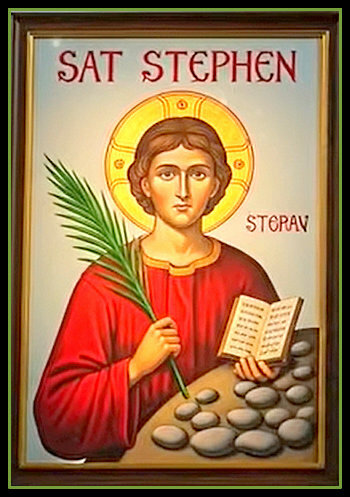
Saint Stephen — The First Christian Martyr
Stephen - The First Christian Martyr
Boxing Day, December 26th, is the Feast of Stephen.
Stephen appears in the Book of Acts when the church at Jerusalem was experiencing internal troubles. Its membership was drawn from two groups of Jews — those who were native Palestinians, and those who belonged to “the Dispersion.”
The latter group consisted of Jews who had been born and raised in other lands; their native tongue was Greek, and so they were called “the Hellenists.”
Rivalry between these two groups had been a feature of Jewish life for a long time, and converts to Christ brought it with them when they entered the Church. This rivalry made the Greek-speaking members quick to complain that their widows were not getting a fair share of the community’s food and financial support.
To resolve the problem, the apostles appointed seven of the Hellenists to administer the Church’s resources and care for its poor. Stephen, described as “a man full of faith and the Holy Spirit,” was one of these seven.
Stephen, set apart by prayer and the laying-on of hands, became the first to do what the Church considers to be the work of a deacon — witnessing to the Gospel by serving the poor.
The Book of Acts speaks of Stephen performing many miracles. These activities brought him into conflict with Jews who shared his own Greek-speaking background. They accused him of blasphemy and hauled him before the council which enforced the law of Moses. There, Stephen gave a powerful speech denouncing the whole assembly because their refusal to accept Jesus Christ revealed their disobedience to God.
Enraged by his words, his audience dragged Stephen out of the city and stoned him to death. Just before he died under the hail of stones, Stephen prayed that Jesus would receive his spirit and forgive his murderers. He thereby became the first Christian martyr — not only because he died for his witness to Christ, but also because he bore witness to God’s will that all, even our worst enemies, may know forgiveness in Jesus Christ.
Norman +