Friday Focus May 08, 2026
“All shall be well, and all shall be well, and all manner of thing shall be well.”

Christina (Tina) McKinlay
May 7, 2026
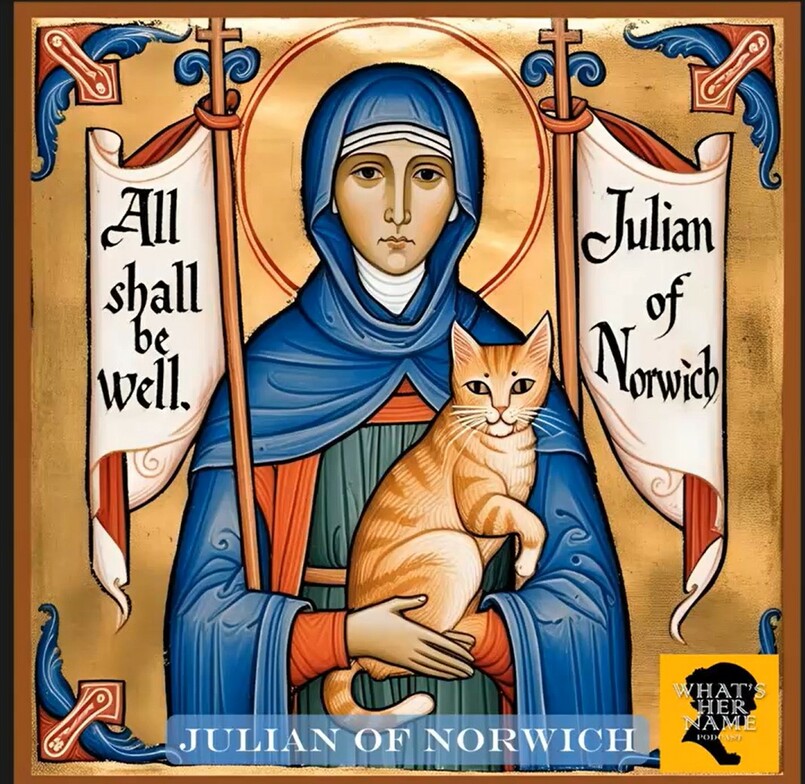
Julian of Norwich
Friday Focus, 8 May 2026.
“All shall be well,
and all shall be well,
and all manner of thing shall be well.”
Julian of Norwich
Imagine lying in bed, gravely ill, convinced you are about to die. The room is dim, the air heavy with the scent of candles and incense. A priest stands beside you, holding a crucifix, urging you to fix your eyes on Christ. This was the scene in May of 1373 for a young woman in Norwich, England — a woman we now know as Julian of Norwich.
She was only 30 years old, and by all accounts, she was at death’s door. Yet in that moment of weakness, she received a series of visions — what she called “showings” — that would shape her life and theology forever.
Julian lived in a time of plague, famine, and war. The Black Death had swept through England multiple times. The Hundred Years’ War raged on. The Church itself was fractured and often harsh in its teaching about God’s judgment.
And yet, in the midst of this, Julian’s visions revealed something astonishing: “All shall be well, and all shall be well, and all manner of thing shall be well.”
This was not naïve optimism. Julian did not deny suffering — in fact, her visions included vivid images of Christ’s agony on the cross. But she came to understand that God’s love is deeper than any wound, stronger than any sin, and more enduring than any sorrow.
Julian saw that God’s love is not just an attribute — it is the very fabric of existence. She famously described holding something small, like a hazelnut, in her hand and realizing it represented all of creation — tiny, fragile, and yet sustained entirely by God’s love. In our own fragile lives, we can rest in the truth that we are held, moment by moment, in the hands of a loving God.
Julian did not receive a promise that life would be free from pain. Instead, she was shown that God can and will bring good out of every evil. When we face loss, illness, or uncertainty, we can cling to the hope that God’s redemptive work is already underway, even if we cannot yet see it.
In a world that often feels chaotic, Julian’s refrain — “All shall be well” — is not a prediction based on circumstances, but a declaration of trust in God’s ultimate victory. Choosing hope is not ignoring reality; it is choosing to see reality through the lens of God’s promises.
This Sunday is Mother’s Day. In her writings Julian spoke of Jesus as “our Mother” because his love for us mirrored the love of a mother for a child. Just as a mother nourishes a child, Jesus nourishes us. Just as a mother cares for a child in sickness and health, Jesus cares for us. Just as a mother patiently instructs a child, Jesus instructs us. And just as a mother will lay down her life for a child, Jesus lays down his life for us.
And so, we pray for all mothers:
Gracious God, we thank you for all mothers. Fill their hearts with laughter and joy. Surround them with love from family and friends. Grant them health, peace, and fulfillment as they pursue their calling. Let them know their value and worth in Your eyes and ours.
In Jesus’ name, Amen.
Norman+
Julian of Norwich