Friday Focus, July 17, 2026
“What I Want is Mercy”

Christina (Tina) McKinlay
July 17, 2026
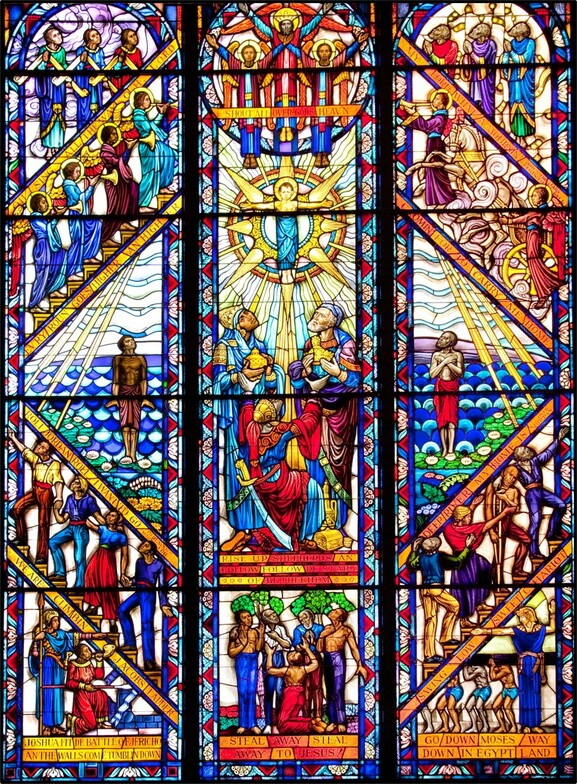
Singing Windows
Friday Focus, 17 July 2026, “What I Want is Mercy” (Matthew 12.1-8)
“What I Want is Mercy”
In today’s gospel, Jesus accuses his critics among the Pharisees of condemning the blameless.
The Pharisees condemned Jesus’ disciples for plucking corn on the Sabbath to satisfy their hunger. The Pharisees regarded such ‘work’ as a form of reaping — which was forbidden on the Sabbath according to the Law.
However, Jesus in his response to their criticism, reminds them that if they were as ‘attuned to their own religious tradition’ as they claim to be, they would not have condemned the ‘blameless’.
He reminds them that the overriding value in the Jewish tradition is ‘mercy’, and he points out that there are precedents in the Jewish Scriptures for what his disciples are doing.
The Sabbath rest was an important value; however, ‘mercy’ is a greater value in God’s eyes.
Jesus reminds us that the actions of others need to be viewed with the eyes of mercy — eyes which seek to understand why people are doing what they are doing — eyes which recognize that basic human needs take priority over the keeping of religious law.
The failure to look upon others with eyes of mercy often results in the condemnation of the blameless.
The temptation to condemn ‘the blameless’ is always with us.
Too often we are quick to judge and to condemn others because we are offended by — or do not understand — their words or actions. It is a temptation we can resist to the extent that something of God’s merciful vision has taken root in our lives, and thus we are able to distinguish what is important from what is not important.
Jesus’ whole life witnessed to this truth.
In today’s gospel Jesus says to his disciples, ‘Here I tell you is something greater than the Temple’.
In those days it would have been difficult to conceive of anything greater than the Temple.
Herod’s Temple in Jerusalem was considered to be one of the wonders of the world. It was revered as the focal point of God’s presence. Yet, Jesus claims to be greater than the Temple because he is the new focal point of God’s presence.
God was present no longer in a building but through a person, through Jesus, Emmanuel, God with us.
It is because he is Emmanuel that Jesus speaks of himself in our gospel reading as Lord of the Sabbath.
He is not just Lord of the Sabbath, but Lord of all, Lord of the church, Lord of our lives.
Because he is Lord of our lives, we are called to submit to his word so that his priorities become our priorities. Acts of mercy, such as feeding the hungry, take priority over our rush to judgement or any narrow understanding of the Law.
Norman+
image:
Singing Windows
Stained glass
J. & R. Lamb Studio 1932
"In 1932, artist Katherine Lamb Tait was commissioned to design a window using as a design motif, 11 songs most often described as Negro spirituals. In 1957, the chapel was destroyed by fire.
Lamb’s designs had been preserved and were used to recreate the Singing Window when a new chapel was built between 1967-1969."
fr: Art in the Christian Tradition, a project of the Vanderbilt Divinity Library, Nashville, TN.